Your battle map. Tonight.
One prompt, one minute, one finished map. No learning curve.
5 maps free✓ No credit card at signupCancel anytime
One account, the whole session
Make the map. Run the fight on it. Keep the campaign.
Every one of them is live today, and every one is on every plan, including the free one. The character sheet, the homebrew builders and the dice come with the membership, $2.99 a month.
Describe it, browse to it, or draw it
Type a few words and get a finished battle map, drill down through guided presets when you would rather not start from a blank box, or roll a floor plan and have the art painted onto the walls you drew.
- One quality setting, and it is the good one: no cheap tier to avoid
- Draw mode: your floor plan is the input, so the map keeps your geometry
- Map types from a whole settlement down to a single room
- A full range of art styles, and AI editing in plain English
- Grid overlay, high-resolution export, PNG / JPG / WebP
- Yours to keep, forever, with no subscription lockout
Every kind of map
A generator for each kind of place
Every type below is its own generator, with its own subject list, its own materials and its own idea of what a room is. A tavern is not a dungeon with furniture in it.
Outdoors
Open ground, where the party is between places.
- Wilderness
- Road & Travel
- Water & Coast
Settlements
Places with people in them, from a hamlet to a city block.
- City Street
- Camp & Battlefield
- Village & Town
- Farm & Homestead
Structures
Built things, cut away so you can see every room at once.
- Building Interior
- Castle & Keep
- Ship & Vessel
Underground
Below the surface, where the corridors matter as much as the rooms.
- Dungeon & Crypt
- Cave & Underdark
- Ruins & Hideout
Legendary
The room the campaign has been walking toward.
- Arena & Boss Chamber
- Monster Lair
- Divine & Planar
Any art style, on any of them
Pick the look after you pick the place. The same layout renders as a clean VTT plan or as a page from a sourcebook.
How you start
Browse it, describe it, or draw it
A blank prompt is the reason most map tools go unused. It is not the only way in.
BrowseGuided presets
Pick a family, a type and a subject, then tune it with chips. Nothing to write, nothing to know.
- Culture, upkeep, what happened here, lighting, weather and season
- Every choice is a real prompt fragment, not a mood word
- Wish for me rolls the whole thing at random
CustomDescribe your own
Type what you want in plain English. The Genie turns it into a full prompt, then adds the framing and scale itself.
- Art style, area size in feet and framing are appended, never guessed
- Frame shapes: landscape, square, wide, portrait, panoramic and round
- Map mode for a 90 degree battle plan, Scene mode for the illustration
DrawRoll a layout
Roll a set of floor plans, edit the one you like, and finish it. No AI, no credits, no waiting: the plan is the map.
- Free and unlimited on every plan, including the free one
- Set the map size in squares, from a single room to a battlefield
- Move, Room, Passage, Door, Stairs, Water, Solid and Erase, snapped to 5 ft
- Exports a VTT scene with the walls and doors already built
Draw mode
You draw the dungeon. The AI paints it.
Most AI maps put the rooms wherever they land. Here the floor plan is the input: roll one, drag the walls where you want them, and the finished art keeps the geometry. The plan is a real file too, so if you only wanted the plan, take it and spend nothing.
- Several plans a roll, deterministic from a seed you can keep
- Density, shape and how looping the routes are, on sliders
- Every room reachable by construction, with a warning if you wall one off
- Drops straight into Roll20 or Foundry at 70px per 5 ft square
Made with RPGenie
Every one of these came out of the map generator
No touch-ups, no hand-editing. Click any image to see it full size.
Loading…
Animated maps
Torch flicker. Flowing water. Drifting mist.
Every one of these is a map from the gallery above, animated in the app and exported as video. The terrain stays exactly where you put it: only the things that would move on their own actually move. An animated map costs 8 credits from your normal balance, and every account gets one free.
A river running under a bridge · 1 / 8
What you get
The maps, the table and the campaign, on every plan.
All of it is unlocked on every tier, free one included: the generator, the live table you run the fight on, and the campaign that holds it all together. What you pay for is how many credits you get, plus the tools marked below.
Campaign prep
The session, ready before anyone sits down
A campaign holds your sessions, your notes, your maps, your props and the party's shared pouch, and it hands each player their own link. It is prep, deliberately: anything that changes while dice are being rolled lives on the table instead. Free on every plan, including the free one.
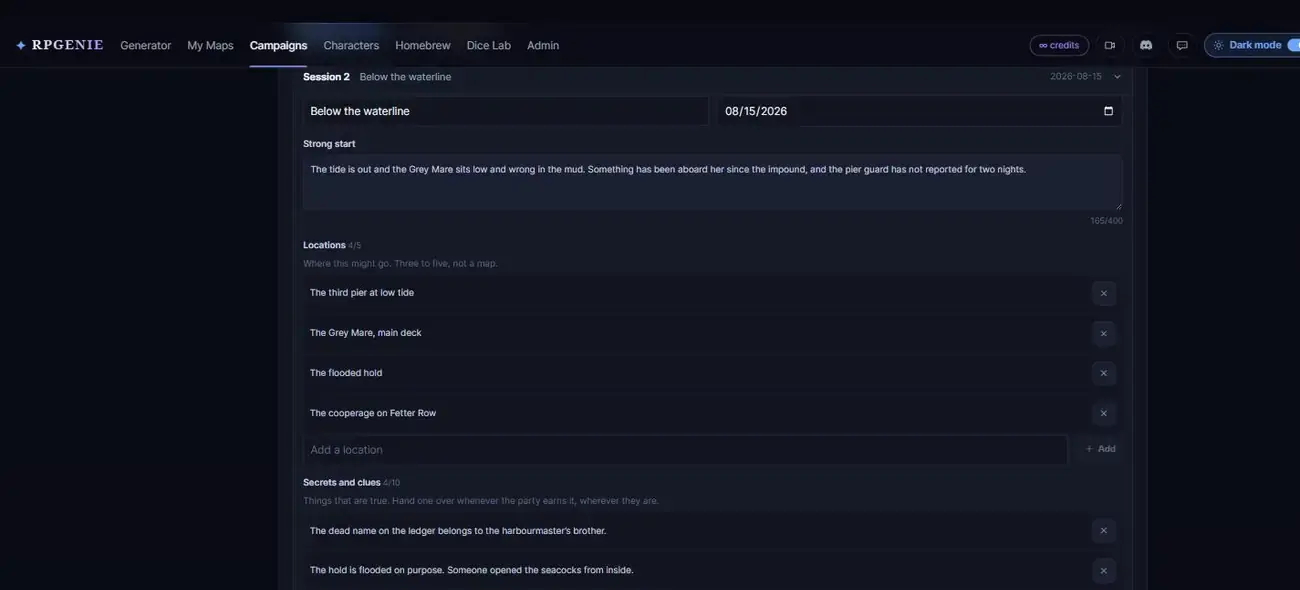
Sessions, not scripts
A strong start, the places this could go, the secrets you are willing to give up, and names ready for the shopkeeper nobody planned. Every field is deliberately capped: prep that fills a page is prep nobody reads with people waiting.
A notebook that remembers
Write a note, tag it, flag it as a quest, and find it again by tag or by searching. It is the same notebook the character sheet carries, so yours and your players' behave the same way.
Props you can actually hand over
A letter, a wanted poster, a torn scrap, a page from a journal, a tavern board. The paper is real and the words are your own text on top of it, which means a typo is an edit rather than a regeneration, and making one costs nothing.
Your maps, filed where you will find them
Maps made in the generator get filed to a campaign, renamed to what the room is actually called, sorted into areas, and put up on the table in a press.
One pouch for the whole party
Shared items and coins with a weight and a total, that anyone at the table can add to. Hand something over and it lands on that character's sheet with its weight, rather than in a message nobody scrolls back to.
A shopkeeper who is the same next week
Roll a vendor with a trade, a settlement, a temper and a shelf of stock, and their haggle comes with them. The seed reopens the identical shop, so the party can go back and find the same person behind the counter.
It writes the recap for you
The table quietly logs what happened while you played it. Afterwards, draft a recap from that log, edit it into your own voice, and publish it to the players. Secrets you never revealed cannot get into a draft.
A seat and a link for each player
Add everyone once and hand out a personal link. Rotate it or drop it whenever you like, and nobody has to make an account to use it.
The table
Put the map down and run the fight on it
Any map you make opens as a live table. Send your players the link and they are in: no account, no install, nothing to download. It runs in a browser on a phone, a tablet or the television in the corner, and it is on every plan including the free one.
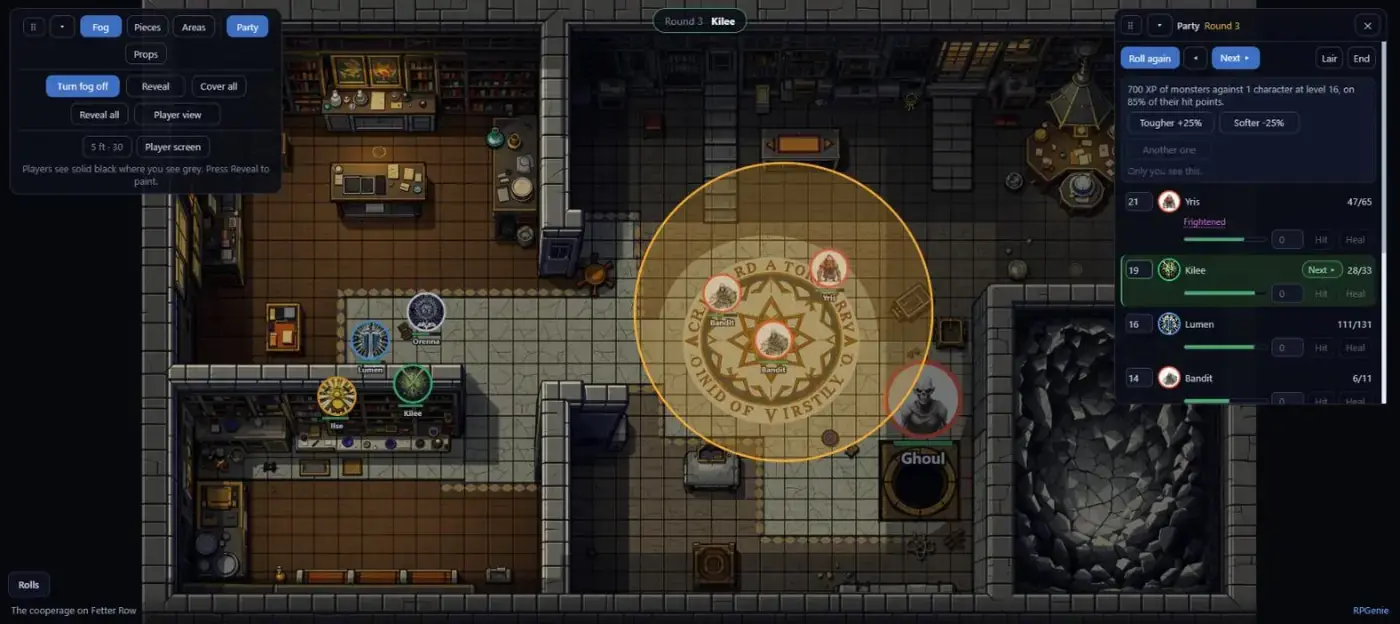
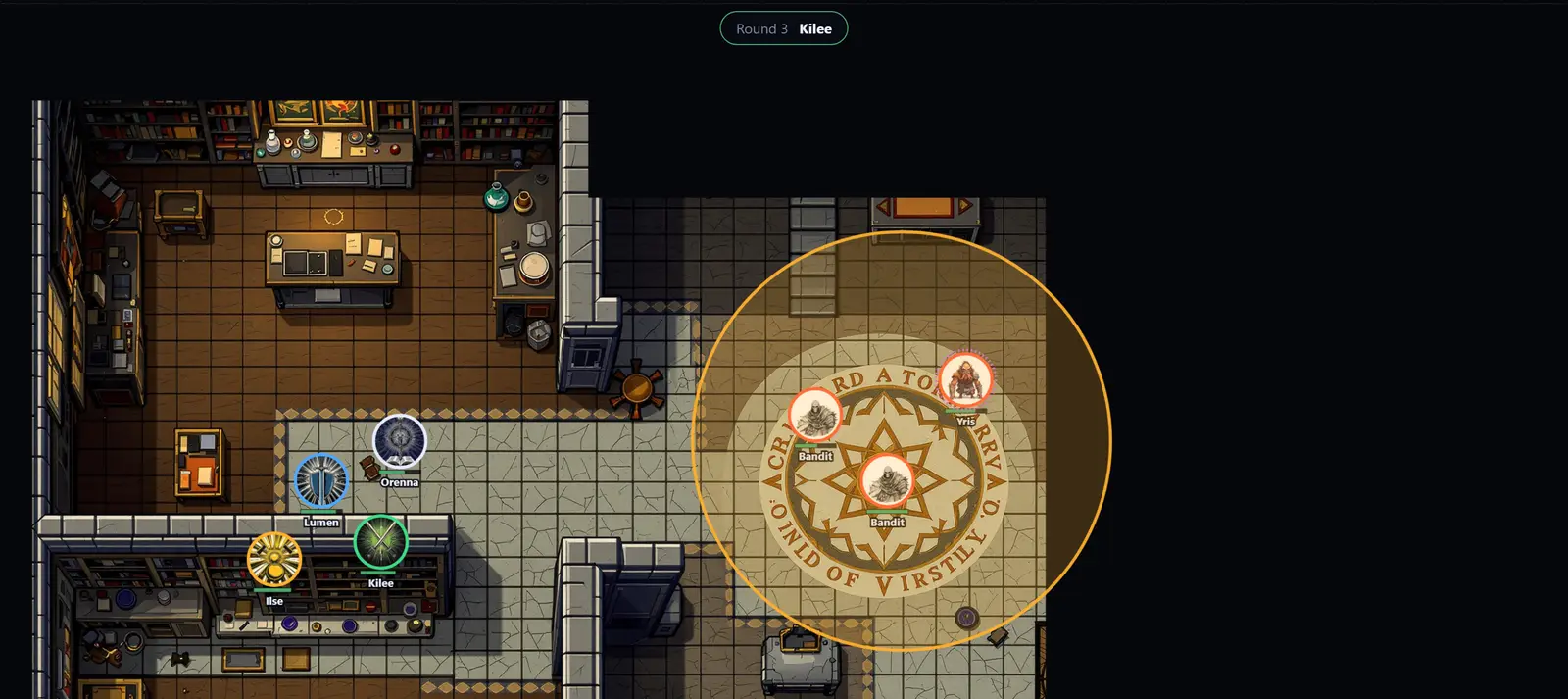
Fog you paint, not a switch you flip
Drag to reveal, hold shift and drag to take it back. Players see solid black where you see grey, and Player view drops you into their screen before you commit to anything. On a map drawn in Draw mode it can follow the walls you drew, so a corner is a corner.
Pieces for the party and everything else
Party tokens bound to real character sheets, a creature library with filters, class discs and plain markers. Set a size, a sight radius, a ring colour and a name. Putting a piece on the map costs nothing at all.
Initiative that keeps a fight moving
Roll for the whole room, step through the order, and drop a lair action in on its own count. Every row carries hit points, temporary hit points and a damage box, so landing a hit is a number typed into the row rather than a conversation.
Conditions in words, counting down
Every condition in the rules, written in plain English on the creature that has it and ticking down as the rounds pass. When something takes damage while concentrating, the table asks for the save and remembers what broke.
Spell areas measured in feet
Cones, circles, lines and cubes, sized in feet rather than in guesswork. Calibrate the grid once by dragging across a square you know, and the chip in the corner says so out loud until you have.
Everyone sees the roll
Rolls made on character sheets at this table land in a log everybody can open. A natural 20 becomes something the room watches rather than something one person announces.
It reads the fight for you
The party card weighs what is on the board against the party actually standing in front of it, and offers to make the encounter tougher, softer, or one bigger, before anyone has rolled.
A second screen for the room
Player screen opens a clean window for the television, in sync with yours and carrying none of your controls. Or hand out the link and let everyone use the phone already in their hand.
Every player gets their own page
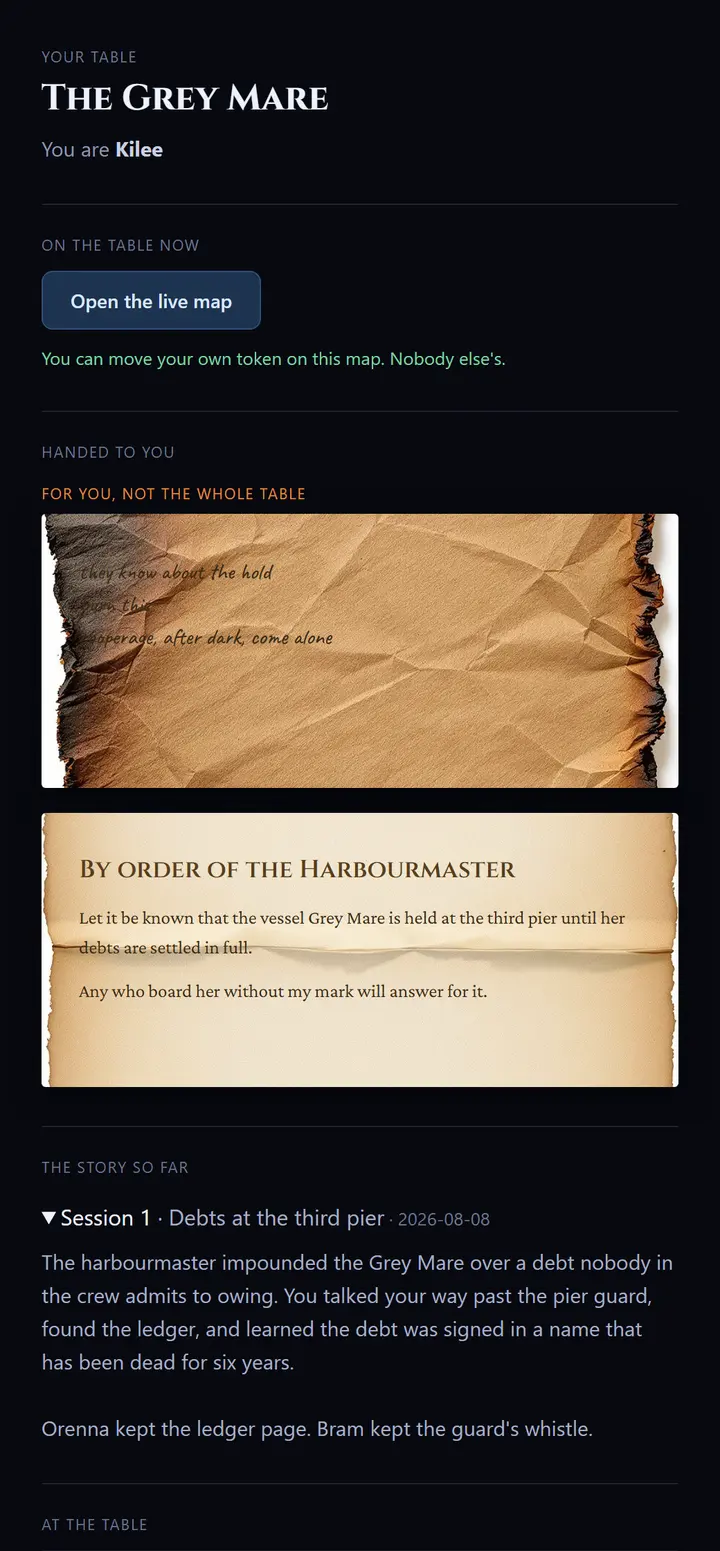
One link each, opened on the phone already in their hand. It carries the live table, whatever you have handed them, the story so far, the party pouch, and who else is at the table with what hit points.
A prop sent to the whole room and a note meant for one person look different on purpose: anything private is marked as private on the page it arrives on, so nobody reads a secret out to the table by accident.
Nobody signs up, nobody installs anything, and the page updates itself while it sits open. A player who does have an account can link their character sheet, and the table starts showing their hit points and conditions to the DM.
Character sheets
A character sheet you can actually play with
Built on the official free rules that publishers use, the SRD 5.2.1, so the species, classes, spells and items are all in there. Every number it can work out, it works out, and it tells you where the number came from. Included with any paid plan.


It does the arithmetic, and shows its working
Armor class, initiative, every skill and save, passive scores, max HP, spell save DC and spell attack per class, attacks per action and your crit range. Hover any of them and it names what it added up.
Multiclassing that follows the book
Add as many classes as you like up to level 20. Hit dice pool by die size, caster levels combine, and prerequisites warn you rather than blocking you, exactly as the rules say they should.
Spellcasting, per class
One stat card per casting class. Spell slots and Pact Magic tracked separately with their own recharges. Preparation limits, ritual and concentration flags, upcasting, and always-prepared spells that arrive on their own.
An inventory that weighs things
Equipped, containers, quest items and overflow. Attunement counted, charges tracked and spendable, coins and encumbrance optional per character, and a modifier editor deep enough for a legendary item that grants a spell.
Rest, spend, recover
Short rest, long rest and dawn each recharge the right things. Class resources are pip trackers, hit dice roll on the real dice, and the number that settles is the HP you get back.
Conditions, curses and Wild Shape
Every condition in the rules plus exhaustion, feeding the advantage badges everywhere else. Lycanthropy and vampirism ship built in. Druids transform into any known form and the beast takes over the sheet.
Companions and a portrait
Familiars, mercenaries, monsters and companions with fully editable stat blocks and live hit points. Portraits are generated from a guided wizard that already knows your species and class.
Themes and backdrops, per character
Aether, Ember, Parchment, Arcane, Atlas, Grove, Crypt and Midnight, set per character. Backdrops for every class and species. Everything saves itself as you type.
Homebrew
Your own creations, and the books on your shelf
Write up the species, class or item you invented, or enter the material you already own so the sheet can do the arithmetic on it. None of these are a notes field: what you make is wired into the same engine as the official content, so your feat produces a real advantage badge on a real roll.

Species
Lineages with traits, senses, speeds and mechanical effects.
Classes
Level by level: hit die, saves, spellcasting and features that wire in.
Subclasses
Paths layered onto any class, official or your own, gated by level.
Backgrounds
Skills, an ability score pool, a granted feat, tools and languages.
Feats
A fixed ability bump plus effects, choosable in any feat slot.
Boons
The level 19 reward: an ability increase past the normal cap, and something worth waiting for.
Spells
Full casting info, attack or save, damage, and into any spellbook.
Items
Stats, modifiers, charges and spells the item can cast.
Creatures
Familiars, monsters and companions. Beasts double as Wild Shape forms.
Curses
Afflictions you catch and carry until cured. Or write your own.
One effect editor, shared by every builder
Every builder shares the same effect vocabulary, so a bonus you attach to a species behaves exactly like one attached to an item. Each effect can be gated to a level and can name its own source.
Start from something that already works
Every builder can clone an official entry, or one of your own, as a starting point. Change only what you wanted to change instead of typing a class out from nothing.
- Applying homebrew stores a frozen copy on the character
- So editing your library later cannot rewrite a live character behind your back
- Homebrew appears in the same pickers as the official content, under its own heading
Dice
d4 to d100, with weight to them
The Dice Lab is where you forge a set, equip it and tune how it throws. Whatever you equip is what rolls on your character sheet.

Real physics, not an animation
The dice are rigid bodies in a real world with a floor and walls. The number is read off the face that settles upward, so nothing decides the result before the throw does.
It knows what you are rolling for
Roll from the sheet and it brings the modifiers with it. If anything on your character grants advantage, it throws the extra die and keeps the higher, and advantage and disadvantage cancel the way they should.
Natural 20s get their moment
A crit on the attack arms the damage roll for that specific weapon, so the dice double themselves when you roll damage. House rule available if your table maxes instead.
Skins, including ones you invent
A set built in for each sheet theme. Or describe one in a sentence and have it made: polished malachite with gold veins, pale bone carved with faded runes.
Pricing
One plan. $2.99 a month.
There is no tier to work out. $2.99 a month unlocks everything the app can do and comes with 20 credits, and unused credits roll over for two months. Credits buy generations: one credit is one AI map, and a re-roll or an AI edit is a new generation, so it uses one too. Draw mode costs nothing at all, on any plan, including the free one, and so do the live table and the campaign manager.
Try a finished character sheet, and roll its dice. No account needed →
Trial
Free
✓ No credit card at signup
Membership
$2.99/mo
15¢ per credit
What a credit buys
One balance covers all of it. An animated map is 8 credits because video costs far more to make than a still image. Every account also gets one animated map free.
Need more credits?
Top up any time, on any plan including the free one. Pack credits never expire and they stack on top of your monthly ones.
Campaign Atlas
$19.99
20¢ per credit · never expire
All maps are yours to keep forever. Monthly credits reset on the 1st and unused ones roll over for two months. Cancel anytime.
Community
Share maps. Ask for features. Get them.
The Discord is where new tools get argued into existence before they get built.
Discord communityUnlocked on any paid plan
Your next session starts here
Five credits, the full generator, the live table and the campaign manager, free and without a card. Add the character sheet, the homebrew builders and the dice whenever you upgrade.